
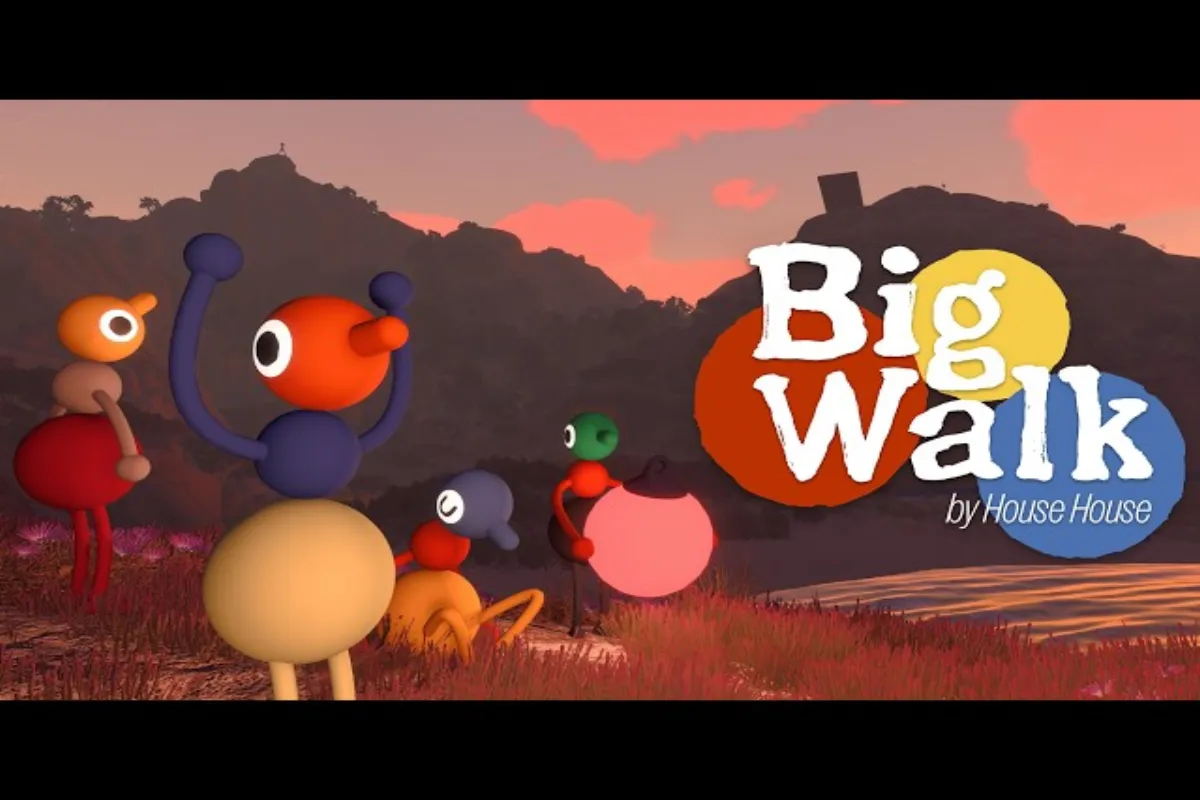
Tucked inside a fictional stretch of Australian bushland, Big Walk has emerged from one of the strangest development arcs in modern indie gaming: a project that grew out of shared Zoom calls, neighborhood walks at two-meter distances, and the quiet realization that physical presence is something players actually crave. The game's DNA traces directly back to pandemic-era isolation, and the team's response to that experience now defines nearly every system in the finished product, including the diegetic Big Walk soundtrack you hear at every radio tower, footbridge, and valley lookout.
How COVID Lockdown Inspired Big Walk's Co-op Design
Big Walk began as a sketch on a shared virtual whiteboard during the worst weeks of Melbourne's extended lockdowns. The team at House House was already emotionally drained by months of remote collaboration on prior projects, and the absence of casual hallway chat, whiteboard scribbling, and spontaneous "hey, come look at this" moments produced what studio co-founder Stray Ghostway described in interviews as a kind of creative malnutrition. According to a GamesIndustry feature on the Big Walk developers, the Big Walk COVID lockdown inspiration crystallized when the team asked themselves a deceptively simple question: "What if we built a game whose entire reason for being was to put people back in the same room?"
That single sentence is now the spine of the entire design document. Every system, from wayfinding to puzzle difficulty, is tuned so that 2 to 12 friends who load in together must rely on real-world proximity voice chat, gesture cues, and improvised tools to progress.
The Three Pandemic-Era Problems Big Walk Solves
The development team publicly broke down the project in three concentric circles during a 2024 GDC talk, and these remain the cleanest summary of why Big Walk COVID lockdown inspiration matters to players.
| Pandemic Problem | Game Design Response |
|---|---|
| Loss of spontaneous contact | Walkie-talkie proximity that fades silently when you stray apart |
| Burnout from "always-on" chat | Designated quiet zones with no comms at all |
| Creative starvation from isolation | An open world with hundreds of landmarks begging exploration |
Why the Open World Looks the Way It Does
The setting, a lush coastal wilderness that draws from Victoria's Wilson's Promontory National Park, is essentially a love letter to the bushwalks that Australians rediscovered once lockdown rules finally eased. House House researchers reportedly took dozens of documented field trips during 2021 and 2022, photographing moss patterns, river crossings, and the exact way eucalyptus leaves drift onto gravel paths. That obsessive cataloging shows up in-game because the Big Walk soundtrack literally changes based on which biome you are physically standing inside.
The Six-Year Journey from Lockdown Sketches to Release
The numbers around Big Walk's timeline look unremarkable until you understand how thin the team's resources were during the conceptual phase. Only two designers were formally allocated to the prototype for the first eighteen months, and the rest of the studio pulled double duty on contract obligations while still hunting down grants, applying to festivals, and applying to publisher Panic for development support.
Timeline of Key Milestones
| Year | Milestone | Connection to COVID Lockdown Inspiration |
|---|---|---|
| 2020 | First whiteboard concept | Remote ideation during Melbourne lockdowns |
| 2021 | First playable vertical slice | Field walks replace canceled office playtests |
| 2022 | Open world scope locked | Bushwalking becomes both research method and morale |
| 2023 | Panic signs publishing deal | Diegetic music system prototyped |
| 2024 | Multiplayer closed beta | Proximity chat tuned using community feedback |
| 2025 | Cross-platform testing begins | Steam, PS5, Switch 2 parity locked |
| 2026 | Global release on August 4 | Six-year arc completed |
The full arc from a quarantine-era conversation to a 2026 launch is unpacked in our Big Walk six year development breakdown, but the compressed version is this: the team used isolation as a design brief, not a constraint, and that gave Big Walk a thematic center that few co-op games can match.
The Diegetic Big Walk Soundtrack and Audio World
Audio is the quiet hero of Big Walk, and the Big Walk soundtrack is unlike anything the genre has attempted before. The team chose a diegetic structure on purpose, meaning every note you hear exists inside the world rather than floating above it as score. Composers AKSFX, Sam Gill, and Luke Neher were each handed a terrain archetype early in production, and their stems are triggered by spatial proximity to hand-placed objects.
How Diegetic Music Actually Behaves in Big Walk
| Trigger Object | Composer | Audio Behavior |
|---|---|---|
| Bogged river transmitter | AKSFX | Looping drone that gains intensity as a group converges |
| Treetop observation deck | Sam Gill | Sparse piano phrases that overlap only when multiple players linger |
| Granite outcrop trail markers | Luke Neher | Field recordings layered beneath a slow, walking-tempo hum |
That structure means there is no global ambient layer under the Big Walk soundtrack. Players who split the party hear entirely different soundscapes depending on which biome they wander into, and a group that reassembles at a checkpoint gets a brief, unplanned chord progression that acts as a tiny emotional reward for staying together.
Mood Versus Mechanic
This kind of design looks like flavor until you realize it also solves a real co-op pain point. In most open-world co-op games, players drift because the world rewards drifting with new loot, new quests, and new music stings. Big Walk deliberately withholds those rewards. The richest Big Walk soundtrack moments are reserved for gatherings at summits, camp restorations, and crest-clear scenes. According to the official Big Walk press kit, this was a specific post-pandemic design choice: the music itself is teaching players how to be present with one another.
The Composers, Sound Designer, and Field Recording Process
Behind every note is a small team that leaned hard into analog gear and outdoor microphones during a period when touring for sample libraries was impossible. The Big Walk COVID lockdown inspiration extended well past gameplay into the actual recording sessions, which were largely conducted in whichever Victorian forest the team's travel bubble could reach.
Who Made the Big Walk Soundtrack
| Role | Name | Contribution |
|---|---|---|
| Composer (lead) | AKSFX | Boggy wetland transmitter pads, river bed drones |
| Composer | Sam Gill | Treetop piano phrases, lookout stingers |
| Composer | Luke Neher | Trail-marker hum, granite outcrop textures |
| Sound designer | Em Halberstadt | Foley, footsteps, animal foley, weather |
Em Halberstadt's contribution deserves its own callout because the footstep library alone took fourteen months to build. Each surface in the game (moss, gravel, boardwalk, wet sand) generates a distinct texture, and the footsteps crossfade based on walking speed rather than transitioning abruptly. That level of fidelity makes the Big Walk soundtrack feel inhabited rather than overlaid.
Field Recording as Lockdown Therapy
For the first two years of prototyping, the team treated field recording as both a research method and a morale exercise. Engineers drove hours outside Melbourne to capture dawn birdsong, river wash, and rain on canopy for what eventually became diegetic ambient beds. Those recordings also seeded the House House Melbourne studio workflow that we covered previously, and several were preserved in the game's credits as a love letter to the landscapes that saved the team's sanity during isolation.
Player Experience, Reception, and What Comes Next
Six years after the original lockdown sketches, Big Walk COVID lockdown inspiration has matured into the studio's most ambitious release and arguably its most personal. Player reception through the early access build on Steam praised the lack of a UI-heavy score, the conversational quiet that the proximity chat enables, and the rare feeling of finishing a session slightly out of breath from walking up an in-game mountain with friends. Critical outlets compared it favorably to prior House House work like Untitled Goose Game, but emphasized that Big Walk trades single-player mischief for shared, restorative presence.
Big Walk vs Other Co-op Walking Simulators
| Title | Year | Player Count | Audio Approach |
|---|---|---|---|
| Big Walk | 2026 | 2–12 | Diegetic only |
| Firewatch (1-player reference) | 2016 | 1 | Traditional score |
| A Short Hike | 2019 | 1–4 | Adaptive score |
| Unpacking | 2021 | 1 | Sparse diegetic cues |
The studio confirmed in the same round of interviews that a long-term roadmap is planned, including seasonal weather updates and a small set of new biomes, though core systems around the Big Walk soundtrack are unlikely to change because they are load-bearing for the emotional promise of the game.
For readers interested in the broader developer profile and the Australian indie scene that birthed House House, the House House Melbourne studio profile explores how the team grew from a tiny four-person outfit into a globally recognized creative voice. Together, all of these threads paint a single portrait: Big Walk is a project that owes its existence, its mechanics, and its music to one of the loneliest periods in modern memory, and it manages to transmute that loneliness into one of the warmest multiplayer experiences you can buy in 2026.
What is the Big Walk COVID lockdown inspiration, and how can players trace it back inside the game itself? Look for the in-game postcards, the wildlife sign at the trailhead, and the quiet, two-minute pause at every summit, because those are the breadcrumbs the team intentionally left for anyone who lived through the same moment that started it all.
Frequently Asked Questions
Q: Can I play Big Walk solo without other players?
While Big Walk is designed as a cooperative experience, you can explore the world solo. However, certain puzzles and areas require at least two players to complete, so solo walkers will find some content gated behind multiplayer requirements in the current version of the game.
Where can I find evidence of the Big Walk COVID lockdown inspiration in the finished game?
You can spot it in the postcard collectibles scattered along trails, in the audio diaries at ranger huts, and in the way stations themselves reward gathering rather than sprinting. According to the Big Walk press kit, each zone contains at least one deliberately quiet, deliberately communal puzzle that only resolves when multiple players choose to slow down and coordinate.
Who composed the Big Walk soundtrack?
The score was composed by AKSFX, Sam Gill, and Luke Neher, with Em Halberstadt handling the game's sound design and foley library. Each composer owned a specific biome, and their stems are triggered by proximity rather than played as a global layer.
Does Big Walk have a traditional background score?
No. The Big Walk soundtrack is fully diegetic, which means music is generated by objects inside the world like transmitters, lookout decks, and trail markers. Players never hear a single continuous ambient bed, which is a deliberate choice rooted in the project's COVID lockdown inspiration.
How many players can experience the soundtrack together at once?
Up to 12 players can roam the same instance, and the audio engine is designed to make proximity matter. When all twelve players converge near a single transmitter, the layered stems briefly harmonize into a moment that community testers have called the most unexpectedly emotional beat in the entire game.