
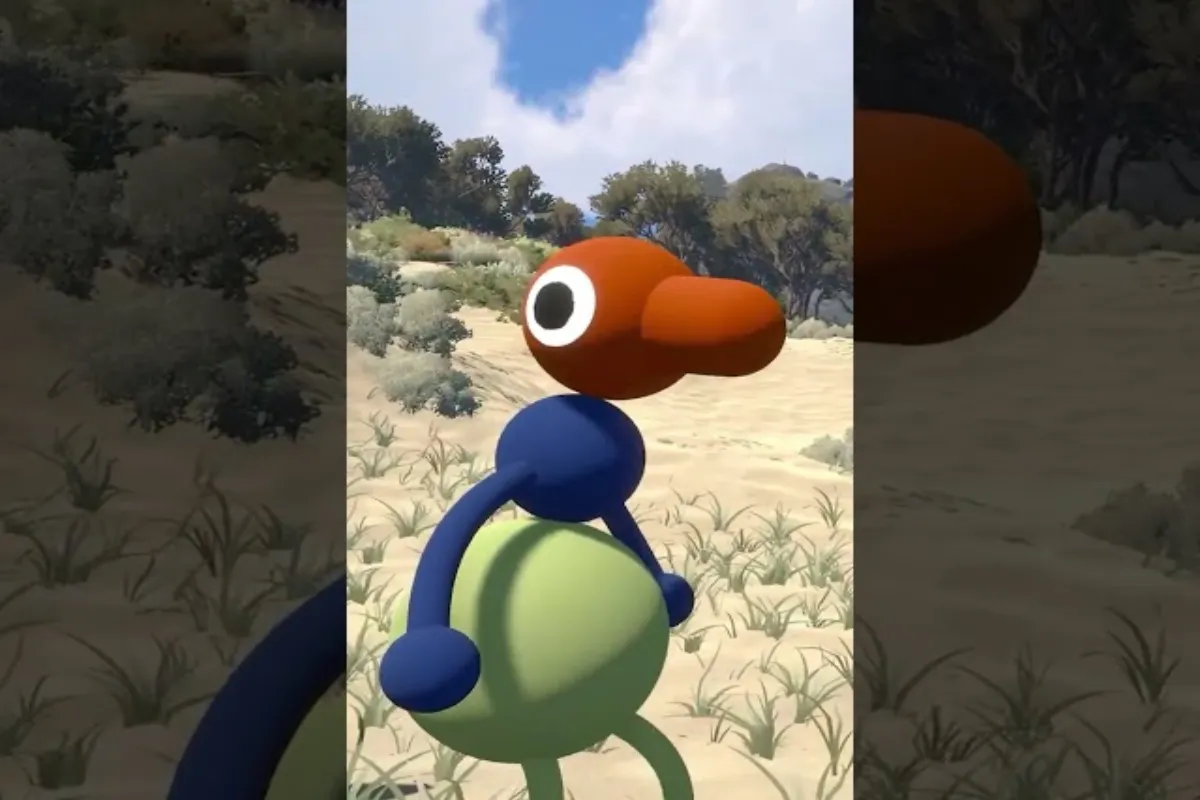
Exploring the Big Walk Open World
The Big Walk open world is a deliberately unhurried sandbox built around walking, listening, and talking rather than rushing toward an objective marker. According to the official Big Walk presskit, the sandbox presents a "wide-open world to explore at your own pace" with multiple distinct areas stitched together by solvable bridges. That single sentence explains almost everything about how the game feels in motion: there is no quest log barking at you, no minimap ticking down a timer, and no enemy lurking at the edge of vision.
What makes this Big Walk open world unusual is its negative space. In a 2024 retrospective, GamesIndustry.biz noted that the developer duo built "downtime between puzzles" into the world itself, allowing players to "breathe and socialize" instead of constantly solving. The map is wide rather than tall, and most of the landmarks are visually quiet — a curved ramp, a yellow boulder, a hut tucked under a tree — rather than dramatic towers or glowing waypoints.
If you have just started a new save file, the world opens up in a specific order. You spawn in a clearing, walk south across a wooden bridge, and gradually unlock larger regions by completing small group puzzles. The whole sandbox can theoretically be crossed in about fifteen minutes of straight walking, but the developers designed it so that curving paths and side trails slow that pace considerably.
What "Open World" Means in Big Walk
Unlike a traditional open-world game that fills empty zones with random encounters, the Big Walk open world treats empty space as a feature. Three principles stand out:
-
No fail states during traversal — you cannot die while walking through the world, only while solving certain puzzles.
-
No competing audio — each region has a single ambient sound layer, which keeps the world calm.
-
No hidden timers — there is no day-night penalty system, no hunger meter, no respawning enemy.
This makes the Big Walk open world feel closer to a walking simulator crossed with a small puzzle game than to something like a survival or action RPG. For a deeper reference of every named place on the map, see our Big Walk world map breakdown.
Iconic Big Walk Landmarks You Shouldn't Miss
The presskit lists a tight roster of named Big Walk landmarks that act as visual anchors across the map. Rather than scattering a hundred points of interest across the map, the developers concentrated personality into a small number of memorable places. The result is that every player ends up with a mental image of the same handful of places, even when they wander off the trail in different ways.
Core Landmark Roster
| Landmark | Region | What Makes It Stand Out |
|---|---|---|
| Sound Shrines | Central plateau | Small wooden huts with tuning-fork-like instruments inside |
| Treehouses | Northern forest | Multi-platform cabins connected by rope ladders |
| Jungle Gym | Eastern play area | Climbing frame built from timber and rope |
| Ocean Zone | Western edge | First place most players see a horizon line |
| Curved Ramp Notes | Southern hills | Long curved slopes that change note pitch as you walk |
| Yellow Boulders | Scattered | Distinctive painted markers that guide pathfinding |
Each landmark doubles as a soft waypoint. You rarely need a compass because the yellow boulders are visible across valleys, and the curved ramp notes can be heard from a surprisingly long distance. According to community reports, players typically recognize these markers within their first hour and use them as informal navigation aids from then on.
Why Big Walk Landmarks Look the Way They Do
The visual language of the Big Walk landmarks leans warm, hand-built, and slightly cartoonish. There are no ruined castles, no neon signs, no sci-fi towers. Instead, you get cabins, hammocks, ramps, and boulders. This choice reinforces the developer intent described in the GamesIndustry interview: the world should feel like a summer camp built by friends, not a frontier outpost.
If you are working through the game methodically, our complete Big Walk locations list maps every named spot to its region, which is helpful when you are trying to figure out which Big Walk landmarks you have not yet visited.
The Big Walk Sunset and Day-Night Cycle
The Big Walk sunset is, by a wide margin, the most photographed moment in the game. The presskit confirms that the world runs on a day-night cycle with beautiful sunsets and sunrises, and that "nights are brief moments, not prolonged darkness." What this means in practice is that you rarely experience a long, scary night — instead, the world dips into twilight, stars come out, and then the sun returns within a few minutes.
How the Cycle Works in Real Time
The cycle moves faster than a real 24-hour clock because the game is built around short play sessions. Most players report a full day cycle lasting roughly twenty real-time minutes, although this can vary depending on whether you are playing solo or with a larger group.
| Phase | Approximate Duration | Player Experience |
|---|---|---|
| Morning | 5 minutes | Bright, clear, ambient birds |
| Afternoon | 7 minutes | Full color saturation, deepest shadows |
| Big Walk sunset | 4 minutes | Orange-to-purple sky, long shadows |
| Night | 2 minutes | Stars visible, soft glow from lamps |
| Sunrise | 2 minutes | Sky cycles back through pink and yellow |
Because the Big Walk sunset window is so short, players often stop whatever puzzle they are working on just to watch it. Community testers regularly mention that this is the moment the audio design shines brightest: the ambient music shifts from neutral pads to slow, warm strings that match the color change in the sky.
Best Spots to Watch the Big Walk Sunset
Three locations consistently rank as the top sunset viewing spots according to player polls:
-
Ocean Zone cliff — clearest horizon line, ideal for screenshots
-
Top of the curved ramp — wide vantage point over the central plateau
-
Treehouse upper platform — frames the sun through wooden beams
If you want to combine a sunset stop with active exploration, the Big Walk exploration guide walks through routes that align with the cycle, so you arrive at each spot just as the sky begins to shift.
How Big Walk Open World Areas Connect
The Big Walk open world is not a single seamless sandbox but rather a network of distinct regions connected by bridges. The presskit describes them as "multiple distinct areas connected by solvable bridges," which means progress between zones usually requires a cooperative puzzle rather than free walking.
Region Layout
| Region | Connected By | Typical Puzzle |
|---|---|---|
| Spawn Clearing | Wooden bridge to Central Plateau | Press a sequence of floor switches |
| Central Plateau | Stone bridge to Southern Hills | Coordinate two players on opposite pressure plates |
| Southern Hills | Rope bridge to Ocean Zone | Pull ropes in rhythm with audio cues |
| Northern Forest | Log bridge to Jungle Gym | Stack crates to reach a high switch |
| Eastern Play Area | Ladder bridge to Treehouses | Climb in alternating order with a partner |
Each bridge introduces a new cooperation mechanic, which is why the Big Walk open world rarely feels repetitive despite having a limited number of regions. You might learn one bridge with a friend, then encounter a similar puzzle with a twist in a different region an hour later.
Why Connectivity Matters for Exploration
Because the bridges double as puzzles, your effective map grows based on how many of them you solve. A solo player who does not enjoy co-op puzzles will naturally spend more time in the regions they can already reach, while a group of friends will likely see the full network within a single sitting. This is also why the negative-space philosophy of the world works: there is always somewhere to wander, even before you have unlocked the next bridge.
Tips for Exploring the Big Walk Open World Effectively
Even though the Big Walk open world is built for calm exploration, a few practical habits can save you time and help you catch the highlights.
-
Walk at varying speeds — sprinting past a region means you will miss the ambient audio layer that signals you are entering a new landmark area.
-
Use the yellow boulders as guides — they are intentionally placed at decision points, and following them usually leads to the next Big Walk landmarks rather than into dead ends.
-
Plan sessions around sunset — if you only have twenty minutes to play, start the session mid-afternoon so you catch the Big Walk sunset before logging off.
-
Bring a friend for bridges — almost every cross-region puzzle wants at least two players, so solo travelers will spend longer in the starting region.
-
Stop at sound shrines — these are easy to walk past, but their tuning-fork audio is the most memorable moment in the Big Walk open world.
-
Screenshot everything — because nights are brief, the sunset window passes quickly, and a good screenshot preserves the color transition.
-
Listen before you look — the curved ramp notes announce themselves through audio before you can see the ramp, which helps when you are navigating fog or shadow.
Common Routes Worth Trying
| Route | Time Needed | Highlight |
|---|---|---|
| Clearing → Ocean Zone | 20 minutes | First sunset view |
| Plateau → Treehouses | 25 minutes | Best vertical exploration |
| Hills → Jungle Gym | 30 minutes | Most puzzle variety |
| Full perimeter loop | 60 minutes | All five regions in one cycle |
Once you have spent a few hours in the Big Walk open world, the routes above start to feel natural, and you can detour freely without losing track of where the next bridge is. For players who specifically enjoy uncovering off-path content, our Big Walk hidden areas guide and Big Walk secret locations guide list the spots that sit just outside the main landmark roster.
Frequently Asked Questions
Q: Can I play Big Walk solo without other players?
While Big Walk is designed as a cooperative experience, you can explore the world solo. However, certain puzzles and areas require at least two players to complete, so solo walkers will find some content gated behind multiplayer requirements in the current version of the game.
How big is the Big Walk open world?
The Big Walk open world covers roughly the footprint of a small countryside park, with five main regions linked by bridges. While the whole map can be crossed in about fifteen minutes of straight walking, most players spend five to ten hours exploring because of the puzzles and ambient design.
Where are the best Big Walk landmarks for first-time visitors?
If you are new to the game, prioritize the Sound Shrines, the Ocean Zone cliff, and the Treehouse platforms. These three Big Walk landmarks are easy to reach, visually distinct, and they frame the Big Walk sunset from three completely different angles.
How long does a Big Walk sunset last?
A typical Big Walk sunset lasts around four real-time minutes, which is part of a twenty-minute full day-night cycle. Players often pause their puzzles during this window because the audio and color shift only happens once per cycle. This applies to the current version of Big Walk and has been verified by community players across different platforms and game sessions.
Can you experience Big Walk sunset in every region?
Yes, the skybox and lighting are global, so the Big Walk sunset is visible from every region. The Ocean Zone, the curved ramp, and the Treehouse are simply the most popular viewing spots because of their horizon lines.