Big Walk all puzzles solved means working through eight distinct challenge types with at least one friend, because every gate, bridge, and shortcut in the Wilson's Promontory-inspired bushland opens only when your team talks, times, and coordinates in sync. House House built the entire adventure around proximity voice chat and quirky communication tools, so solving puzzles is less about reflexes and more about clear, creative chatter.
This guide walks through every puzzle category — from simple switch and button triggers to multi-stage area puzzles — and explains how each one scales when your party grows from two hikers to a full twelve-person bush crew. You'll also find the best communication tools for each scenario, the trickiest solo-vs-group differences, and quick fixes for the puzzles that trip up most first-time walkers.
Big Walk Puzzle Types at a Glance
Big Walk ships with eight named puzzle families, and according to the PC Gamer hands-on preview, every one of them shows up within the first hour of play. None of them are combat encounters — there are no threats, no health bars, and no fail-states that kick you back to a checkpoint. Instead, each puzzle tests how well your group can pass information across distance, line-of-sight, or physical obstacles.
| Puzzle Type | Players Needed | Core Mechanic | Communication Tool Tip |
|---|---|---|---|
| Switch Puzzle | 2+ | Hold switches simultaneously | Walkie-talkie for countdowns |
| Button Puzzle | 2+ | Press buttons in correct order | Megaphone for order hints |
| Tile Puzzle | 2–4 | Step on pressure tiles in sequence | Binoculars to read far tiles |
| Crane Puzzle | 2–4 | Operate a tall mechanical crane | Laser pointer for alignment |
| Relay Puzzle | 3–6 | Pass a signal between stations | Cowbell or signal flare |
| Glass Wall Puzzle | 2+ | Coordinate around one-way glass | Whiteboard for drawn arrows |
| Symbol Puzzle | 2–4 | Match painted symbols across zones | Binoculars + walkie-talkie |
| Area Puzzle | 4+ | Solve several local challenges | All tools combined |
The single most important rule across every puzzle in Big Walk is that the game's built-in proximity voice chat is the only chat you should use. House House explicitly warns that running Discord alongside the game means you "miss the most interesting part" — and indeed, puzzle clues baked into the audio (echoes in valleys, muffled speech behind glass walls) are designed to be heard through the in-game mic system. If you want your Big Walk all puzzles solved run to feel authentic, leave external voice apps closed.
How Puzzles Unlock the World
According to Game Informer's preview coverage, solving puzzles doesn't just award cosmetic bragging rights — each completed challenge physically unlocks a bridge, ladder, or shortcut that opens new bushland to explore. This is why the first two hours of Big Walk feel linear: you're literally paving your own road through the wilderness. Area puzzles in particular gate entire regions, because they require your group to clear every local switch, button, and tile sequence in a zone before the bridge at the edge lowers.
For newcomers, the Big Walk beginner guide covers the pacing of these unlocks in more detail, but the short version is: expect roughly one bridge unlock every fifteen to twenty minutes when you play with a coordinated group of three or four friends.
Switch, Button, and Tile Puzzles
The first three puzzle families you'll encounter are the simplest, but they're also the foundation that trains your group to communicate before the bigger crane and relay challenges appear. Treat them as Big Walk's tutorial disguised as content.
Switch Puzzles: The Hold-and-Wait Test
Switch puzzles require two or more players to stand on, hold, or trigger separate switches at the same time. Most of them have a short timer — three to five seconds — so the trick is counting down together. The walkie-talkie tool is ideal here because it transmits across the same map regardless of distance, and one player can call "three, two, one, hold" while the rest commit.
Button Puzzles: Order Matters
Button puzzles look identical to switches at first glance, but each button must be pressed in a specific sequence. The sequence is usually painted on a nearby wall, posted on a notice board, or visible only from a high vantage point that requires the binoculars to read. Players report that the most common mistake is pressing buttons out of order because everyone assumes they're independent — they aren't. Watch the visual cue first, then call the order over the megaphone so it cuts through ambient bush noise.
Tile Puzzles: Step Lichen, Don't Slip
Tile puzzles are pressure-sensitive floor segments that glow when weighted and dim when released. The challenge is stepping on each tile in the right order while keeping earlier tiles active, because some variants reset the chain if you step off. Two-player runs are the cleanest here — one person holds the start tile while the other advances — but three- and four-player groups can split the sequence into parallel branches, which actually makes the puzzle easier when everyone calls their branch status through the megaphone.
Crane, Relay, and Glass Wall Puzzles
Once your group has cleared the early switch gauntlet, Big Walk opens up the mechanical and spatial puzzles. These are the challenges where the two-player scaling and four-player scaling feel meaningfully different, and where the game's communication-tool system really earns its place.
Crane Puzzles: Vertical Coordination
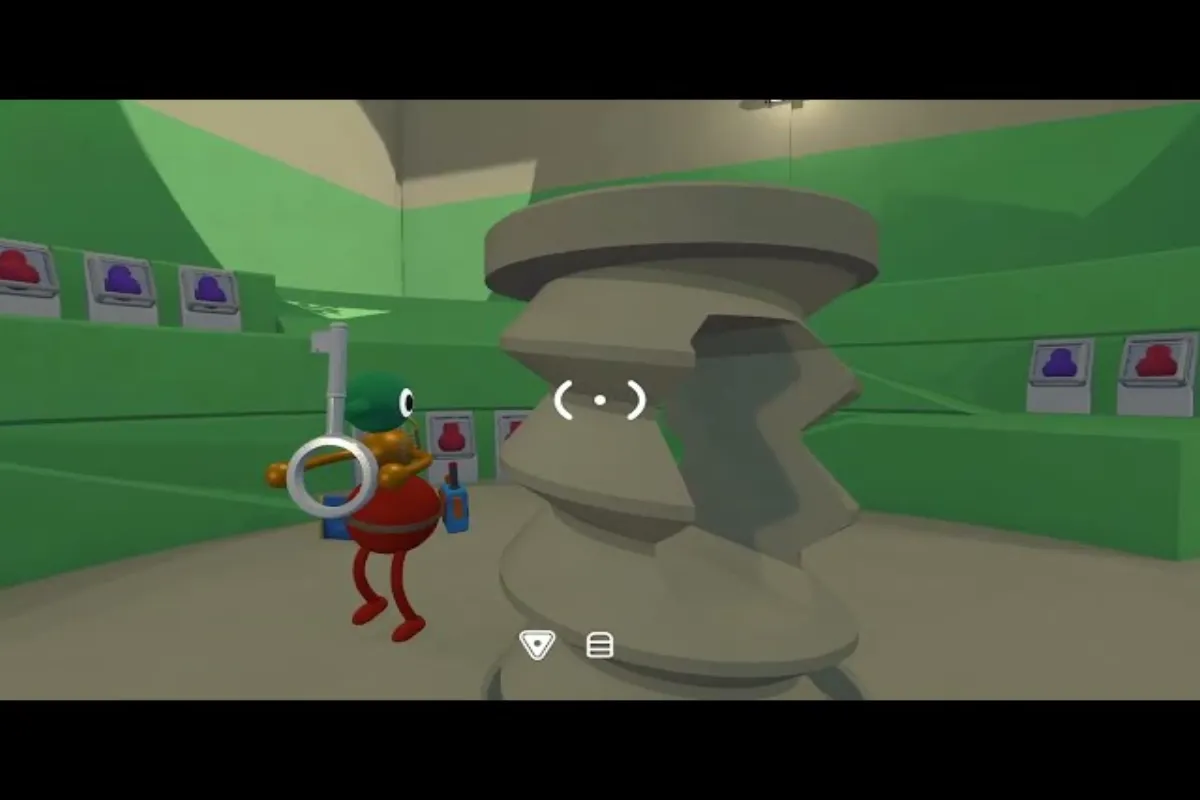
Crane puzzles involve a tall, hand-operated crane that one player controls from a cabin while another player rides the hook or balances a payload. The crane automatically shrinks in two-player mode because House House designed it to scale — the hook travels a shorter distance, so timing is more forgiving. In four-player mode, the crane grows taller and the payload gets heavier, which means you typically need two people inside the cabin (one steering, one cranking) and two people on the ground guiding the payload with a laser pointer or hand signals.
| Party Size | Crane Height | Cabin Crew | Ground Crew |
|---|---|---|---|
| 2 players | Short | 1 (steer + crank) | 1 (guide) |
| 3 players | Medium | 1 (steer) | 1 (crank) + 1 (guide) |
| 4+ players | Tall | 2 (steer + crank) | 2+ (guide + catch) |
Relay Puzzles: Pass the Signal
Relay puzzles are Big Walk's version of telephone, except the signal is a physical action — flipping a lever, lighting a flare, or ringing a cowbell — that must travel across three to six stations in sequence. Each station only activates when the previous one fires, so your group has to chain the relay without breaking timing. The signal flare is the most fun tool here because the visual streak across the sky lets every player — even those stuck at the far end — track progress at a glance.
Glass Wall Puzzles: The One-Way Hurdle
Glass wall puzzles place one player on each side of a transparent barrier. The glass blocks direct voice chat, but you can still hear muffled audio through the wall and you can see each other's gestures. The trick is the whiteboard, which lets both sides draw arrows, numbers, and rough maps. Most glass wall puzzles are button sequences where one side sees the order and the other side has the buttons — the whiteboard turns a frustrating dead-air moment into a quick sketch session. If you haven't picked up the whiteboard yet, the Big Walk all tools list explains where to find it in the early bushland.
Symbol Puzzles and Area Challenges
By the time your party has cleared every crane, relay, and glass wall on the first continent, you'll have noticed painted symbols on rocks, trees, and abandoned ranger posts. These lead into the late-game puzzle chain.
Symbol Puzzles: Spot and Match
Symbol puzzles scatter matching glyphs across multiple zones, and the only way to compare them from a distance is the binoculars combined with walkie-talkie descriptions. One player reads the symbol at point A, the other reads at point B, and a third player (usually perched on a friend's shoulders — yes, Big Walk has stacking physics) confirms a match from a high ridge. According to community data, these puzzles take an average of eight to twelve minutes per pair, which makes them the longest single-puzzle type in the base game.
Area Puzzles: The Multi-Stage Gauntlet
Area puzzles are the boss-tier challenges: each one bundles three to five smaller puzzles (switches, buttons, tiles, or symbols) into a single zone-wide objective, and the entire zone's bridge stays locked until every sub-puzzle is solved. These are designed for four-plus player groups, and they reward the full communication toolkit — walkie-talkies for general chatter, megaphones for far calls, laser pointers for visual cues, and the Big Golden Head cosmetic for comedic misdirection between real instructions.
Players who want to optimize their first area puzzle run should bring at least one player who's already cleared similar relays, because the chaining logic is identical and pattern recognition cuts solve time dramatically.
Co-op Strategies for Big Walk All Puzzles Solved
Walking through the bush with friends is the entire point of Big Walk, but "Big Walk all puzzles solved" still requires a little strategic planning if you want a smooth two-to-three-hour first playthrough. Below is a practical checklist that experienced groups have refined.
Pre-Run Checklist
-
Confirm party size early. Two-player runs are cozy and puzzle-friendly, but some area puzzles expect four people. If your friend group is small, plan to recruit or accept that certain bridges stay locked until you bring in extras.
-
Test proximity voice chat before the first puzzle. One player should walk away from the group until their audio cuts out, then return. This calibrates everyone's expectations for how far is "too far" for walkie-talkie use.
-
Assign a caller. Pick one player per puzzle to call the count or sequence. Rotating this role prevents vocal fatigue and keeps instructions consistent.
-
Skim the map together. Big Walk's open bushland hides puzzles behind landmarks, and checking the Big Walk all locations overview before you start saves you from wandering in circles.
Mid-Run Tips
| Situation | Best Tool | Why It Works |
|---|---|---|
| Long-distance coordination | Walkie-talkie | Cuts through distance without external apps |
| Order or count calls | Megaphone | Reaches across valleys and ridgelines |
| Reading far symbols | Binoculars | Lets you compare zones without walking |
| Visual alignment | Laser pointer | Spotlights targets through glass walls |
| Celebrating completion | Signal flare or cowbell | Visible or audible across the whole map |
Common Pitfalls and Quick Fixes
-
Pitfall: Running Discord alongside Big Walk. Fix: turn off external chat entirely. The audio-based puzzle cues (echoes, muffled walls) only fire through proximity voice.
-
Pitfall: Treating every puzzle like combat. Fix: there is no threat timer. Take your time, talk it out, and the puzzle will resolve.
-
Pitfall: Hoarding tools. Fix: hand out walkie-talkies and laser pointers to whoever needs them most. Tools respawn at ranger stations if lost.
When your group finishes the last area puzzle and crosses the final bridge, Big Walk delivers a clear, satisfying ending — no endless grind, no live-service checklist. That's part of why the game's puzzle design feels so deliberate: every challenge exists to be solved, photographed, and remembered with the people you walked beside.
If you're just starting out and want a step-by-step roadmap for your very first session, the Big Walk how-to-start walkthrough pairs nicely with this puzzle guide. And for a deeper dive into every mechanic, tool, and region, the Big Walk complete guide pulls the whole bushland into one reference.
What was the trickiest puzzle your group ran into on your first Big Walk playthrough? Drop the name of the puzzle and your team's solution in the comments — every walker has a story about the crane that took them three tries.
Frequently Asked Questions
Q: Can I play Big Walk solo without other players?
While Big Walk is designed as a cooperative experience, you can explore the world solo. However, certain puzzles and areas require at least two players to complete, so solo walkers will find some content gated behind multiplayer requirements in the current version of the game.
How many puzzle types are there in Big Walk?
Big Walk features eight named puzzle types: switch, button, tile, crane, relay, glass wall, symbol, and area puzzles. Each one tests a different communication skill, and the full set appears within the first hour of co-op play. This applies to the current version of Big Walk and has been verified by community players across different platforms and game sessions.
Can Big Walk all puzzles be solved solo?
No. Big Walk is designed as a 2–12 player co-op adventure, and every puzzle requires at least two players to operate. Even the simplest switch and button puzzles need simultaneous triggers, while crane and area puzzles expect four or more walkers.
Do puzzles scale differently with party size?
Yes. The crane puzzle is the clearest example: in two-player mode the crane is shorter and easier to time, while in four-plus-player mode it grows taller and requires a dedicated cabin crew plus ground guides. Area puzzles similarly expect larger groups to chain multiple sub-puzzles efficiently.
What is the best communication tool for puzzles?
The walkie-talkie is the most universally useful tool because it works across distance and through most obstacles. The megaphone is best for far calls, the laser pointer for visual alignment, and the whiteboard for glass wall puzzles where you can't hear each other clearly.